Are Ferrari Back? Six Key Talking Points for the Austrian GP
Austrian GP 2026 talking points highlight Ferrari’s resurgence and key performance questions


The Red Bull Ring Is Ready to Shake Up the 2026 Title Fight
After Lewis Hamilton’s stunning maiden Ferrari victory in Barcelona ended Mercedes’ winning streak, Formula 1 arrives in Spielberg with the championship picture genuinely open. Hamilton turned a 66-point deficit into a 41-point one, elevating himself from just ahead of George Russell to a genuine external threat to championship leader Kimi Antonelli.
With technical fireworks on the horizon from multiple teams, the Austrian GP shapes up as one of the most loaded weekends of the season. Here are six key talking points for the Austrian GP 2026 talking points.
1. Ferrari’s ADUO Engine Upgrade: A Genuine Leap or a Small Step?
The biggest story of the weekend centres on Ferrari’s planned power unit upgrade. Ferrari is currently waiting for official approval from the FIA before introducing its upgraded Formula 1 engine, provisionally as early as the Austrian Grand Prix. The team will ship the third version of its 067/6 power unit to Spielberg, featuring modifications allowed under the ADUO (Additional Development and Upgrade Opportunities) framework.
The technical concept is bold. Ferrari has already been operating a notably hot engine concept, with intake air entering the intercooler at more than 100°C, compared with the 60–70°C range typical of more conventional designs and from Austria onward, that limit is expected to rise beyond 115°C.
That architecture is being paired with a new Shell fuel developed specifically for this configuration, with the collaboration between Enrico Gualtieri’s engine department and Shell’s Hamburg laboratory central to Ferrari’s planned step.
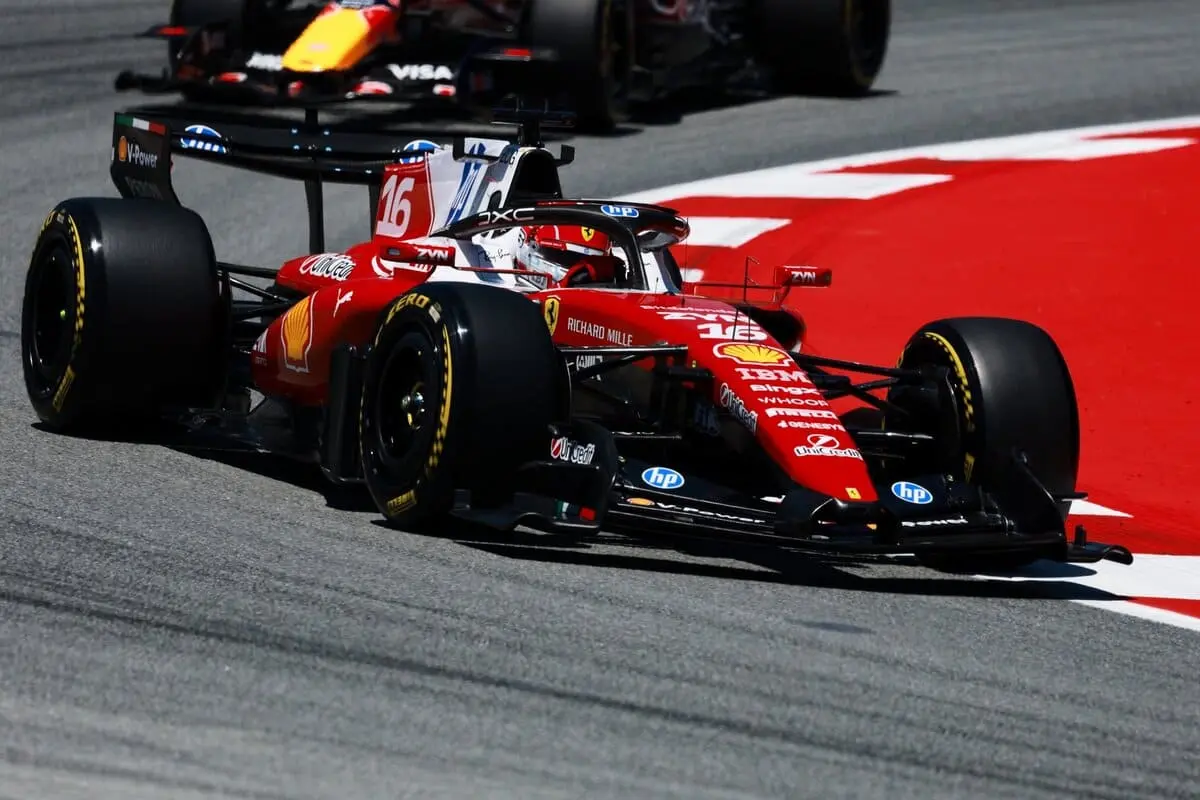
In terms of raw numbers, expectations should be managed carefully. The internal combustion engine revisions should deliver around 4 to 5 horsepower, with the new Shell fuel adding a further 2 to 3 horsepower on top, translating to roughly one-tenth of a second per lap at the compact Red Bull Ring. The true leap in performance is expected to arrive at Monza with “ADUO 2” following the next data assessment in six races.
For a deeper dive into how the ADUO framework is reshaping the power unit war, see our piece on F1’s ADUO Engine Catch-Up Plan Branded ‘Absurd’ and Open to Manipulation, and for the wider picture of Ferrari’s engine deficit, don’t miss High Altitude, No MGU-H: How the 2026 Unknown Is Set to Be a Major Curveball at the Austrian GP.
2. McLaren’s ‘Upside-Down’ Rear Wing Makes Its Debut
Ferrari won’t be the only team turning heads in the technical department. The McLaren F1 team is the latest squad to trial an upside-down rear wing concept at the Austrian Grand Prix, following similar designs at Ferrari and Red Bull, with Ferrari having shocked the paddock in winter testing when it revealed a rear wing that rotated 180 degrees as straight mode was enabled.
McLaren technical director Neil Houldey confirmed the plan ahead of the weekend. “For this event, we’ve focused on minor detail updates around the car’s rear corners, as well as an experimental rear wing that will run throughout Friday’s sessions. While the overall package is lighter than some of our recent updates, these developments are all part of our season-long development pathway.”
The new rear wing is seen as a test item and is not expected to be used in Austria beyond Friday practice, but following careful analysis back at the factory, the design, or a variant thereof, could reemerge later this season as a performance upgrade. McLaren chief designer Rob Marshall had singled out Ferrari’s unique upside-down rear wing as a design idea that had caught his eye earlier in the campaign. Read more about the concept in our feature McLaren Debuts Its Own ‘Upside Down’ Rear Wing at the Austrian GP.
3. The High-Altitude MGU-H Problem Nobody Is Talking About Enough
Beyond the headline upgrades, Austria presents a unique challenge that every team must navigate. Situated in the Styrian mountains at an altitude of 678 metres above sea level, the thinner air will provide a bigger challenge than at lower altitude tracks when it comes to the way the turbo hybrid power units work, with air pressure and density around 92% of sea level, meaning the air is 7.5–8.5% thinner.
This is something the new 2026 power units have not experienced so far, with Williams chief trackside engineer Paul Williams noting: “It is the first time the new PUs will be taken to a high-altitude”, with consequences including more turbo lag, or turbos that have to work harder and run hotter.
As Honda’s Shintaro Orihara explained, the removal of the MGU-H from the 2026 regulations means teams “no longer have the MGU-H to assist the turbocharger, which may make it more challenging to operate both the turbocharger and the engine correctly at high altitude.”
4. Norris’s Warning: Ferrari Would Be “Embarrassing Everyone”
Lando Norris has provided the most candid external assessment of Ferrari’s potential. The reigning champion stated: “We’re lucky that Ferrari doesn’t have a better engine at the minute. If they had a better engine, they’re dominating. They’re the class of the field in terms of cornering performance at the minute. We’re not even close to them.
If they make improvements on the engine side, then they’ll embarrass everyone.” That verdict sets the stakes for what Ferrari’s Austria upgrade could mean for the rest of the season. For context on Hamilton’s own title ambitions, see our piece Hamilton Not Thinking of Title Yet After First Ferrari Victory.
5. Red Bull’s Home Upgrade and Mercedes’ Reliability Cloud
Ferrari may be closing in, but Austria will also bring pressure from Red Bull, which has scheduled a major upgrade package for its home circuit. Meanwhile, Mercedes championship leader Antonelli was on course for another strong second in Barcelona before losing power and coming to an abrupt halt, the second Mercedes retirement in three races after Russell similarly stopped when leading in Canada.
Reliability concerns are now as much a part of the Mercedes story as raw pace. For comparison with how other manufacturers are approaching the engine development race, see our piece on Audi Shocks Rivals With Surprise Engine Upgrade at Barcelona GP.
6. Leclerc’s Barcelona Failure Remains Unresolved
Ferrari’s post-race debrief also focused on the electronic failure that disabled Charles Leclerc’s hydraulic system in Spain, costing him power steering, brake-by-wire and active aerodynamic systems, with engineers still investigating the cause, and suggestions of similarities to Leclerc’s Antony Noghes incident in Monaco. With the title picture tightening,
Ferrari simply cannot afford to hand away points through mechanical gremlins. Higher combustion temperatures also bring genuine risks around cooling, reliability and correlation between the dyno and the track. The reliability issues are set to be significant Austrian GP 2026 talking points.
A Weekend That Could Define Ferrari’s Season
The Austrian GP 2026 talking points are shaping up as far more than a routine round. If Ferrari’s ADUO engine clears FIA approval and delivers on track, McLaren’s experimental wing shows enough promise to be raced later in the year, and the high-altitude curveball creates unexpected results, Spielberg could genuinely scramble the standings.
Ferrari have a short window to turn Barcelona optimism into a sustained championship push, and Austria may now become the first real answer. Given the technical and competitive threads converging at the Red Bull Ring this weekend, it promises to be unmissable.
The RNT Weekly newsletter
Race weekend times, results and our best stories in your inbox. Free, and you can unsubscribe at any time.