Verstappen confirms the McLaren and Mercedes talks, and calls the 2026 cars numb
The four-time champion confirms discussions were serious, and uses Lawson and Tsunoda as proof the 2026 cars reward the wrong things.

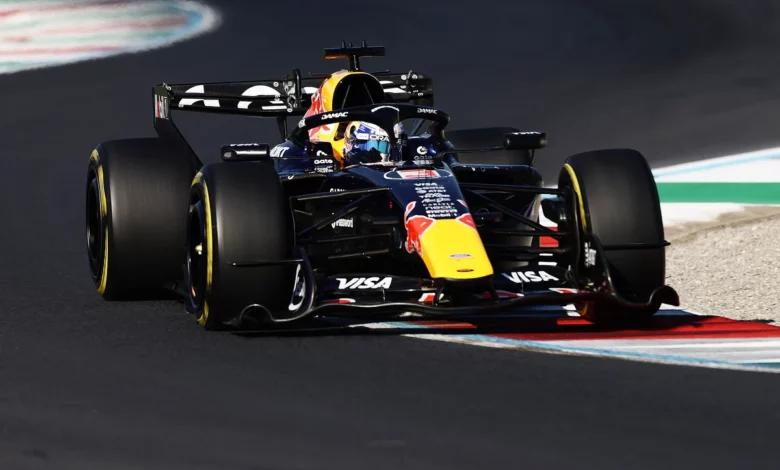
Max Verstappen has confirmed publicly for the first time that he held talks with both McLaren and Mercedes before deciding to stay at Red Bull. In the same BBC Sport interview he made his sharpest criticism yet of the 2026 cars, and he used his own team mates as the evidence.
In this article
Mercedes last year, McLaren this year
The talks were an open secret for months. Verstappen has now put them on the record himself: Mercedes approached him last year, McLaren this year, and he engaged with both.
“Of course, any kind of chat you take seriously,” he said. “They’re all very respectful chats. There’s nothing wrong with that.”
He was equally direct about what that did to his own team. “Of course I can understand that they might have been a little worried at times,” he said. “But at the same time I was mainly concerned about what was going on here.” That is the distinction worth holding on to. He was not looking for the exit so much as pressing on what was wrong inside Red Bull while keeping his options open.
He signed to 2030 without winning a race all season
The decision came in the week before his home race at Zandvoort, when Red Bull announced a two year extension that replaced a deal expiring in 2028 with one running to the end of 2030.
The timing is the striking part. Verstappen has five podiums in 2026 and not a single win. He is committing to a team that has not given him a winning car all year, in a season where Mercedes have run away with both championships.
“I felt that staying was, for me, the right choice. You have to follow your heart,” he said. “I could have run away very early on in my Red Bull career and gone somewhere else to try and win. If you have a little bit of patience, you do end up winning. I feel like that’s my approach now as well.”
The cars are numb to your driver inputs
The second half of the interview is the part that will travel further. Verstappen argued that the 2026 regulations, with their much larger electrical component, have inverted what a racing driver is supposed to be rewarded for.
“In the history of the sport, normally the driver that is the most committed, the latest on the brakes, earlier on throttle, committing in the high speed, they get rewarded, because you just gain that time in the corner,” he said. “But now you’re constantly thinking about, in this corner I might have to hold in a bit. Go later on throttle. Or brake earlier. Or lift off. And then I have more top speed. Stuff like that. It’s so unnatural. It’s so not how it should be.”
He has been saying versions of this since the rules were published, including calling the 2026 cars Formula E on steroids before he had driven one. What is new is that he now has a season of evidence.
Lawson and Tsunoda are his exhibit A
Rather than argue in the abstract, Verstappen pointed at the two seats either side of him. Liam Lawson has been standing in at Red Bull since Isack Hadjar broke his wrist, and Yuki Tsunoda has stepped out of a reserve role back into the Racing Bulls car. Both have scored points almost immediately.
“Liam jumps from the Racing Bulls to the Red Bull, immediately competitive,” Verstappen said. “It’s because these cars are numb to your driver inputs.”
There is a backhanded compliment in there for both drivers, and Lawson in particular might reasonably point to qualifying a tenth off Verstappen at Zandvoort as evidence of something other than a numb car. But the underlying claim is serious: if a driver can move between two different cars and be on the pace at once, the regulations have flattened something that used to separate people.
The engine split moves to 60-40 by 2028
Formula 1 has already accepted part of the argument. The split between internal combustion and electrical power is being changed to 60-40 in two steps by 2028, reducing the share the battery carries.
Verstappen’s response to that was resigned rather than triumphant. “Hoping that it will be better in the future,” he said. “Accepting where we are at.”
Our view: the complaint and the contract are the same story
It is tempting to read these as two separate interviews, the contract one and the regulations one. They are the same one.
Verstappen has signed for four more years with a team that cannot currently win, in a formula he thinks rewards the wrong things. Those two positions only make sense together if you believe the formula is going to change and the team is going to catch up. The 60-40 shift by 2028 is the first half of that bet. Laurent Mekies rebuilding Red Bull’s technical operation is the second.
The risk is obvious. If the 2028 engine changes do not restore the feel he is describing, he has committed the rest of his prime to a sport he has publicly said he does not enjoy driving. He is 28. A contract to 2030 takes him to 33.
He goes to the Madring this weekend for a race nobody has any data on, which for once removes the advantage from the teams who have simply understood these cars best.