The Madring is being called a car killer, and the paddock is not arguing
Williams boss James Vowles, Max Verstappen and a chaotic F3 test with 19 red flags are all sending the same message ahead of Sunday's inaugural Madrid Grand Prix.

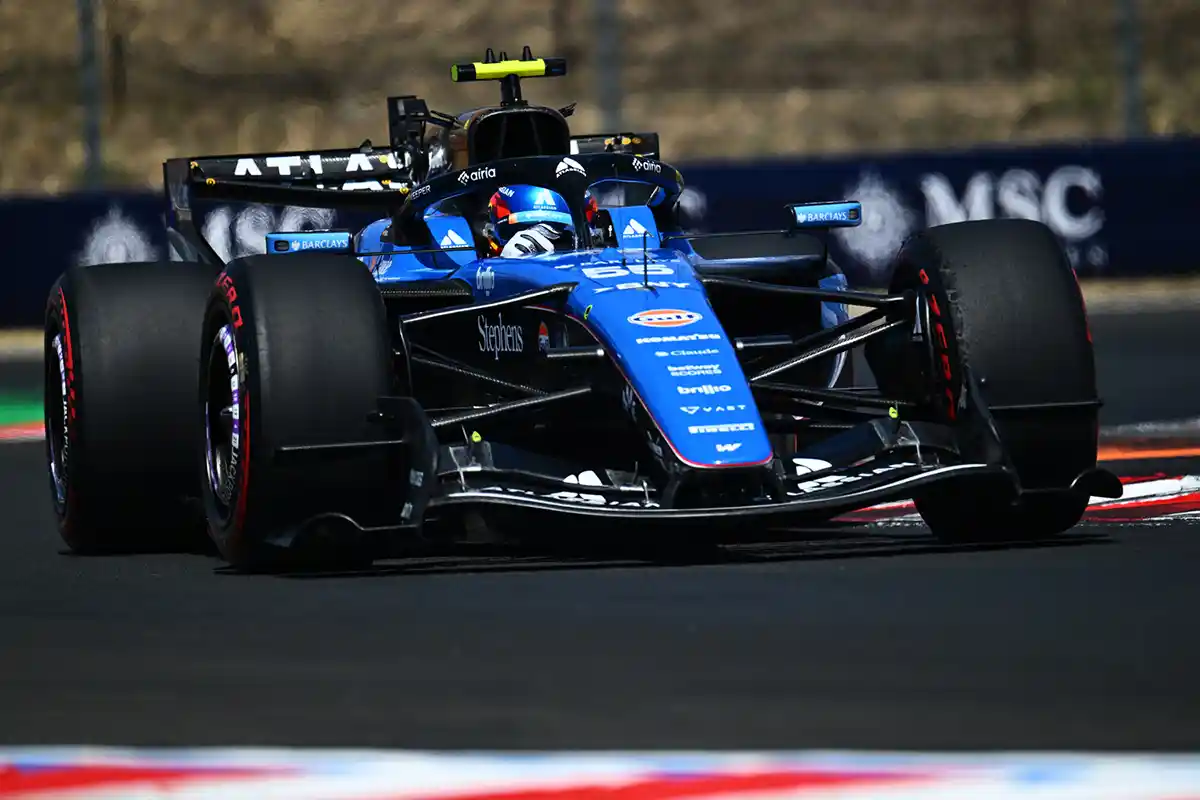
Williams team principal James Vowles has put a label on Formula 1’s newest circuit that nobody in the paddock seems willing to take off it. Speaking to Spanish outlet Sport ahead of the inaugural Madrid Grand Prix, Vowles pointed at the wreckage from a Formula 3 test around the Madring and reached a blunt conclusion: it is a track that kills cars.
He is not the only one. Max Verstappen, who has driven the layout on his own simulator and on Red Bull’s, expects the weekend to produce accidents. Carlos Sainz, the only driver on the grid who has physically been round the place, calls it one of the most challenging tracks he has ever driven in a simulator. Nobody arrives in Madrid with a single lap of real Formula 1 data, and that is the point everyone keeps coming back to.
Nineteen red flags in two days, eleven of them into the barriers
The anxiety did not start with Vowles. It started weeks earlier, at a Formula 3 test that the circuit organiser arranged deliberately. The idea was a pilot episode for the Formula 1 weekend, a way of finding the problems before the world championship arrived, in the way that Las Vegas found its drain covers the hard way in 2023.
Instead of reassurance, it produced 19 red flags across two days. Eleven of them were for cars making contact with the barriers. That second number is the one that matters more than the headline. These were not mechanical failures stopping the session. These were drivers running out of road.
Vowles counted the bill in public. “In the Formula 3 test there were 19 red flags and three broken chassis, broken suspensions,” he told Sport. “OK, they’re Formula 3 drivers, but it’s a track that kills cars.”
What has teams uneasy is where the stoppages happened. They were spread around the lap rather than concentrated at one obvious trap. There is no single corner to survive and then relax. Several Formula 3 teams were left unhappy with the amount of repair work the test generated, which is not the reaction an organiser is hoping for from a dress rehearsal.
La Monumental loads a tyre harder than any corner in 2026
Most of the technical conversation comes back to Turn 12. La Monumental is a semicircular left-hander roughly 550 metres long with a maximum banking gradient of 24 per cent, equivalent to 13.5 degrees, climbing around 10 metres as it goes. It is the longest banked curve on the current Formula 1 calendar. Drivers are expected to arrive between 180 and 200 km/h and hold it flat for around six seconds.
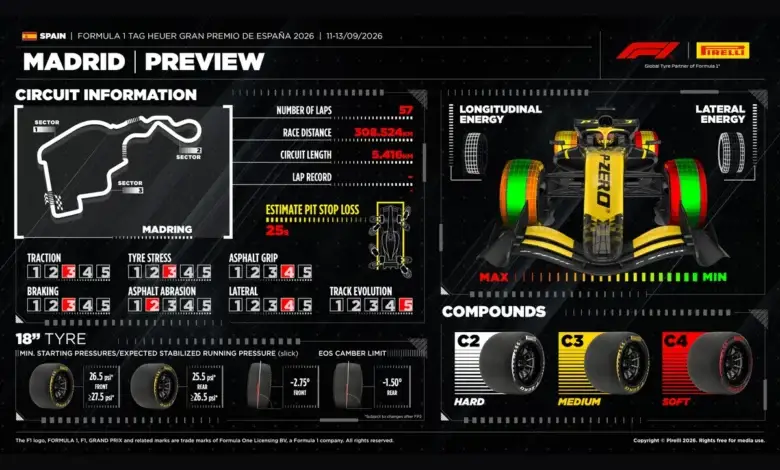
Pirelli’s own assessment is unambiguous. “The Monumental is the corner that generates the highest vertical load of the season, not only because of its banking but also because of its length,” the tyre supplier said in its Madrid preview. Six seconds of peak load, on compounds with no historical data from this surface, in a corner type that does not otherwise exist on the calendar.
Vowles has seen what that does to a Williams in simulation and it clearly bothered him. “It’s four and a half seconds flat out with very high G-forces, which is a challenge for the whole car: tyres, hydraulics, everything,” he said. “It’s something that doesn’t yet exist on the calendar, it’s unique.”
Pirelli has nominated C2, C3 and C4 for the weekend, one step softer than a conventional high-load venue would normally get, and rates track evolution at the maximum. Estimated pit stop loss is 25 seconds. Every one of those numbers is a projection rather than a measurement, which is the theme of the entire weekend.

Verstappen expects big shunts and very few overtakes
Verstappen prepared on his home rig and on Red Bull’s simulator, and came away with a verdict that will have sharpened minds along the pit lane. “It’s going to be very difficult. It’s not an easy track. If you do a few laps in a row, it’s always hard to cross the line and say ‘I nailed the lap’,” he said. “It’s very hard. It also has a tendency of creating some big shunts in some places.”
His reference point is the one nobody wanted to hear. “It reminds me a little bit of Jeddah in a way, with fast corners and the walls being very close.” Jeddah produces enormous qualifying accidents, and teams go there with years of correlation data behind them. For Madrid there is none.
On his Twitch channel the Dutchman raised a second concern, and it is the one that could shape Sunday afternoon more than any crash. “The only thing that’s already a bit disappointing is that many of the braking zones are angled,” he said. “This means it’s practically impossible to attack a competitor because you’re braking and simultaneously turning right or left. And that’s the worst thing you can do if you want to create an overtaking opportunity.”
Under the 2026 regulations the layout carries two Straight Mode zones and one Overtake zone. Designated passing places and actual passing are not the same thing, as Zandvoort reminds everyone every year.
Sainz pushes back on the car killer label
Sainz is the one driver with real-world laps of the Madring, having completed a lap in a Ford Mustang GT in May, and he is also the man racing at home this weekend. He is not buying the doom entirely. “I think the ‘car killer’ label is for F3 cars at the moment,” he said at Monza. “We’ll have to see if it’s an F1 ‘car killer’ or not.”
That is a fair correction. Formula 3 fields are young, the cars are tightly matched and drivers take risks that Formula 1 drivers on a Friday afternoon will not. But Sainz was considerably less relaxed about the driving challenge itself. “I had my first proper laps in the simulator with the car and I must say it’s a hell of a challenging track,” he said. “It’s one of the most challenging tracks I’ve ever done in a simulator and for a driver it’s going to be tough. I think it has a mix of Jeddah and Baku.”
He added that it had exceeded his expectations in both directions. “It is probably more challenging than I thought. With all that banking, all that control of the car through there, it will be a big challenge.”
Audi’s Gabriel Bortoleto struck a similar note at Monza. “It looks like a very interesting track, dangerous track, but at the same time very challenging and it’s nice to race in a new track like that,” the Brazilian said.
The cost cap is the part of this story nobody says out loud
Here is the angle that gets underplayed while everyone repeats the car killer line. This is not purely a sporting problem. It is a budget problem, and it arrives at the worst possible point in the calendar.
With ten rounds still to run, most teams are working out exactly how much development headroom they have left inside the 2026 cost cap. A destroyed chassis at a circuit nobody has mapped is not just a repair bill. It is a chunk of the remaining season’s upgrade programme spent on carbon fibre that goes in a skip. Team principals arrive in Madrid needing their drivers to find the limit quickly on a track that punishes anyone who finds it a centimetre too late.
Red Bull already knows how thin the margins can get. Isack Hadjar’s continued absence through injury means the team is managing its resources with one hand tied behind its back before a wheel has turned.
Madrid begins a ten-year tenure on Sunday
The Spanish Grand Prix will be held in Madrid from 2026 to 2035 under the agreement with IFEMA Madrid, taking over from a Barcelona race that moves to an alternating slot. It is Formula 1’s latest push towards urban population centres, and it starts with a 5.416 km lap of 22 corners around the IFEMA complex, run over 57 laps and 308.524 km.
Practice begins on Friday 11 September at 13:30 local time, qualifying is at 16:00 on Saturday and the race starts at 15:00 on Sunday 13 September. Whether the Madring delivers a race or a procession behind safety cars is the one question none of the simulators can answer.
The RNT Weekly newsletter
Race weekend times, results and our best stories in your inbox. Free, and you can unsubscribe at any time.