Mercedes must act on grid penalty dilemma
Both Antonelli and Russell are on the edge of power unit limits, and Mercedes must now decide where to take the hit.


Kimi Antonelli and George Russell are on the edge of exceeding their power unit allowances. The team is bracing for painful grid drops in the second half of the season, and the big question is: when and where do they take them?
In this article
The Mercedes grid penalty dilemma explained
Mercedes deputy team principal Bradley Lord has admitted it is “almost inevitable” that both Antonelli and Russell will have to take grid penalties in the second half of 2026. That is a remarkable admission for the championship-leading team to make, but it reflects a tough reality.
Antonelli has already used four internal combustion engines, four exhaust sets, three energy stores and three control electronics, all of which are at the upper limit. Whenever a driver exceeds the number of power unit elements, they get a grid penalty. If just one element is exceeded, it is a 10-place grid drop, and if multiple parts are replaced, they could be sent to the back of the grid.
Lord said: “Looking at how many components we have used in the first half of the season, it is almost inevitable that at some point there will be penalties to take. The strategy team and the guys in Brixworth will work to figure out the optimum route through the rest of the season.”
So the Mercedes grid penalty dilemma 2026 is not really about “if” anymore. It is about “when.” And that is where it gets interesting.
Why Monza is on Mercedes’ radar for Antonelli
Mercedes is weighing up the ideal moment to take inevitable engine penalties, with Monza emerging as a surprising option. Team principal Toto Wolff said Monza is one of the circuits under consideration. The Italian track makes overtaking possible, making it one of the better tracks to bounce back from a grid drop.
Of course, Monza is Antonelli’s home race as an Italian, which adds extra emotion to the decision. Any deducted points could make the title race much closer, with Lewis Hamilton, Charles Leclerc and Russell still in the mix. Mercedes will have to weigh short-term pain against long-term gain.
Mercedes boss Toto Wolff said he “still very much hopes we don’t need to take” penalties, but the balance of probabilities is not on Mercedes’ side. That is honest. And it shows just how seriously the team is treating this Mercedes grid penalty dilemma 2026.
Russell’s engine situation is just as serious
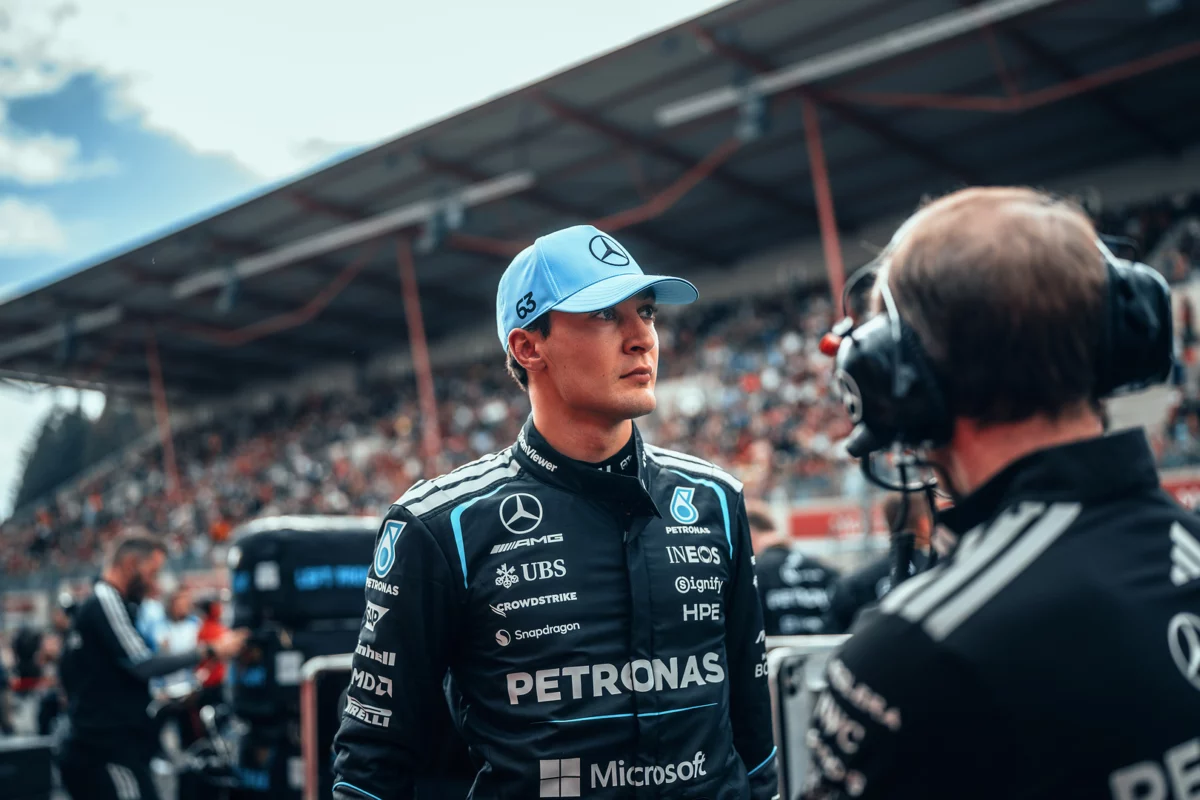
Russell is still within his allowance for the year, but the Hungarian GP version is the fourth and final power unit he can take before a punishment. The early shift to the fourth engine, just one race after Antonelli also had to do the same, has left both Mercedes drivers facing almost certain grid penalties over the second half of the season.
Russell failed to finish at Montreal after a battery failure, before encountering deployment issues at Silverstone and Spa. At the Hungarian GP, he then had to take the last of his permitted engine changes after suffering a water leak during Q3 qualifying.
Russell could get a temporary reprieve, with Mercedes set to ship his damaged engine back to Brixworth for a detailed analysis to see if it can be brought back into action. Every healthy component they can recycle matters enormously right now. You can read more about how strategy calls shape championships in our piece on Hannah Schmitz and race strategy in F1 for example.
Mercedes W17 upgrade is already in production
Despite the penalty headaches, Mercedes is not standing still on performance either. Deputy Technical Director Simone Resta has revealed Mercedes will bring a “sizeable” upgrade on the W17 after the F1 summer shutdown.
Mercedes will introduce more upgrades to the W17 after the summer break, with the team promising a “decent” performance uplift. While Red Bull, Ferrari, and McLaren have all introduced bigger upgrade packages in the first half of the season, Mercedes’ upgrade approach has been more measured. That changes now.
Mercedes Deputy Technical Director Simone Resta confirmed the team is targeting a bigger upgrade once F1 returns for the Dutch Grand Prix at the end of August. That is a statement of intent from a team that wants to re-establish dominance.
What this means for the 2026 title fight
Mercedes is 72 points clear of Ferrari in the constructors’ standings, and Antonelli has a 50-point buffer in the drivers’ contest, but the W17 has come under more pressure from rivals in recent races.
The Mercedes grid penalty dilemma 2026 adds a fascinating strategic layer to the second half of the season. A well-timed penalty weekend at a track like Monza, where overtaking is possible, could limit the damage. A poorly timed one at a street circuit could cost Antonelli or Russell crucial points. Mercedes is conscious of the threats posed by McLaren and Ferrari, both of which are planning aggressive development rollouts after the summer break.
This story is far from over. The Silver Arrows have the pace and the upgrade firepower, but managing these power unit penalties will be just as important as lap time in the months ahead. For the very latest on how all of this plays out, keep an eye on our F1 2026 season coverage right here on rnt-motorsports.com.
How qualifying works: six drivers are eliminated in each of Q1 and Q2 in 2026, and Q3 now runs to thirteen minutes. Our guide to F1 qualifying explained covers the full format, the 107 percent rule and sprint qualifying.