Hannah Schmitz: the Red Bull race strategy engineer reshaping F1
A closer look at how Hannah Schmitz reshapes Formula 1 strategy through precision, calm leadership and the perspective celebrated in our Through Her Eyes series.


In this article
Her start at Red Bull
Schmitz was born on 2 May 1985 in England and studied mechanical engineering at the University of Cambridge, graduating with a master’s degree in 2009. Her specialism was not engines or aerodynamics. It was optimisation, regression analysis and statistical modelling. That is exactly the kind of brain that wins championships in the data-saturated world of modern F1. Even before she touched a pit wall headset, she was leading the Cambridge University Eco Racing team in the World Solar Challenge in Australia, managing a high-pressure engineering project under real competitive conditions.
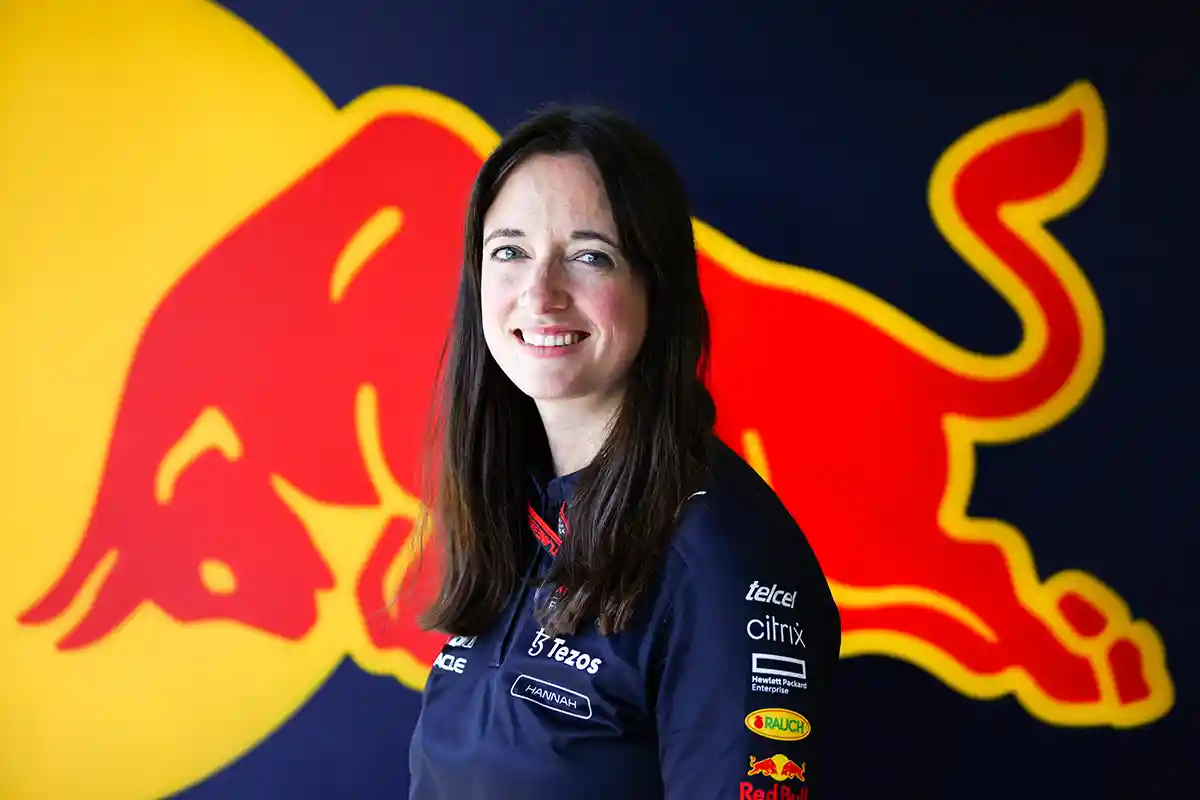
She joined Red Bull Racing in November 2009 as a Modelling and Strategy Engineer. The timing was perfect. The team was on the verge of a dominant era and needed people who could translate raw data into race-day decisions at speed. Schmitz was exactly that. By 2011 she had been promoted to Senior Strategy Engineer, and by 2021 she held the title of Principal Strategy Engineer. When Will Courtenay departed for McLaren, she stepped up to Head of Race Strategy in 2026, the role she holds today.
The calls that defined her career
You cannot talk about Red Bull’s recent history without talking about strategy, and you cannot talk about Red Bull strategy without talking about Schmitz. She played a key role in Red Bull’s Constructors’ Championships in 2022 and 2023, and in Max Verstappen’s four consecutive drivers’ titles from 2021 through 2024. Those are not footnotes. Those are the defining results of a generation in Formula 1.
But the moments that really reveal her quality are the specific calls. Brazil 2019: a third pit stop that looked bold at the time and delivered a race win. Monaco 2022: a perfectly timed strategy for Sergio Perez. Hungary 2022: a soft-tyre undercut that carved through the field. The Dutch Grand Prix the same year. And Qatar 2025: a contrarian safety-car pit stop that went against the grain and paid off. These are not accidents or lucky reads. They are the product of someone who has built and stress-tested her decision frameworks over more than fifteen years.
Schmitz is also one of a very small number of women to have collected a constructors’ trophy on the F1 podium, doing so at Brazil in 2019 and again at Qatar in 2025. That detail matters more than it might seem. The podium is where the sport photographs its winners. Seeing her there is not just symbolic. It is accurate.
One of the most senior women on an F1 pit wall
The conversation around women in motorsport can sometimes drift into tokenism or vague encouragement. Schmitz cuts through all of that. She won the Female Engineer of the Year award in 2022, a recognition that reflected her standing among peers, not just her gender. In 2026, Turn 6 at Albert Park was named after her and Haas engineer Laura Müller as part of the “In Her Corner” initiative, which celebrates the contribution of women across motorsport. That is a meaningful and visible acknowledgement from the sport itself.
In interviews, including coverage by Formula 1, Schmitz has made the point that calmness, confidence and technical depth are not gendered qualities. Women can lead strategy departments in F1. She is proof of it. Her view, drawn from her own career, is that women are not an exception in this sport. They are a growing and necessary presence that makes the paddock more diverse, more innovative and more professional.
She is also increasingly a mentor within Red Bull, guiding younger engineers through the kind of high-stakes environment that can be overwhelming without the right support. Her public profile has grown alongside her seniority, with more interviews, awards and podium moments building a platform she is clearly using with purpose.
A job built on probability and nerve
The honest answer is that very few people can do what Schmitz does. The role demands someone who can hold a complete probabilistic picture of a race in their head, update it in real time as new data arrives, and then communicate a decisive recommendation to a driver and team principal who need to act immediately. Schmitz has spent seventeen years building exactly that capability. She combines Cambridge-level analytical precision with the kind of cold composure that only comes from experience under pressure.
Red Bull’s dominance over the past several seasons did not happen because they had the fastest car on every circuit. It happened because they made fewer mistakes and more brilliant calls than anyone else. Hannah Schmitz is a significant reason why. She is not just one of the best female engineers in Formula 1. She is one of the best engineers, full stop.