Russell delays his grid penalty until the Mercedes ADUO upgrade arrives
George Russell will wait for the ADUO-spec power unit before taking his grid drop, with Austin now the most likely target race.


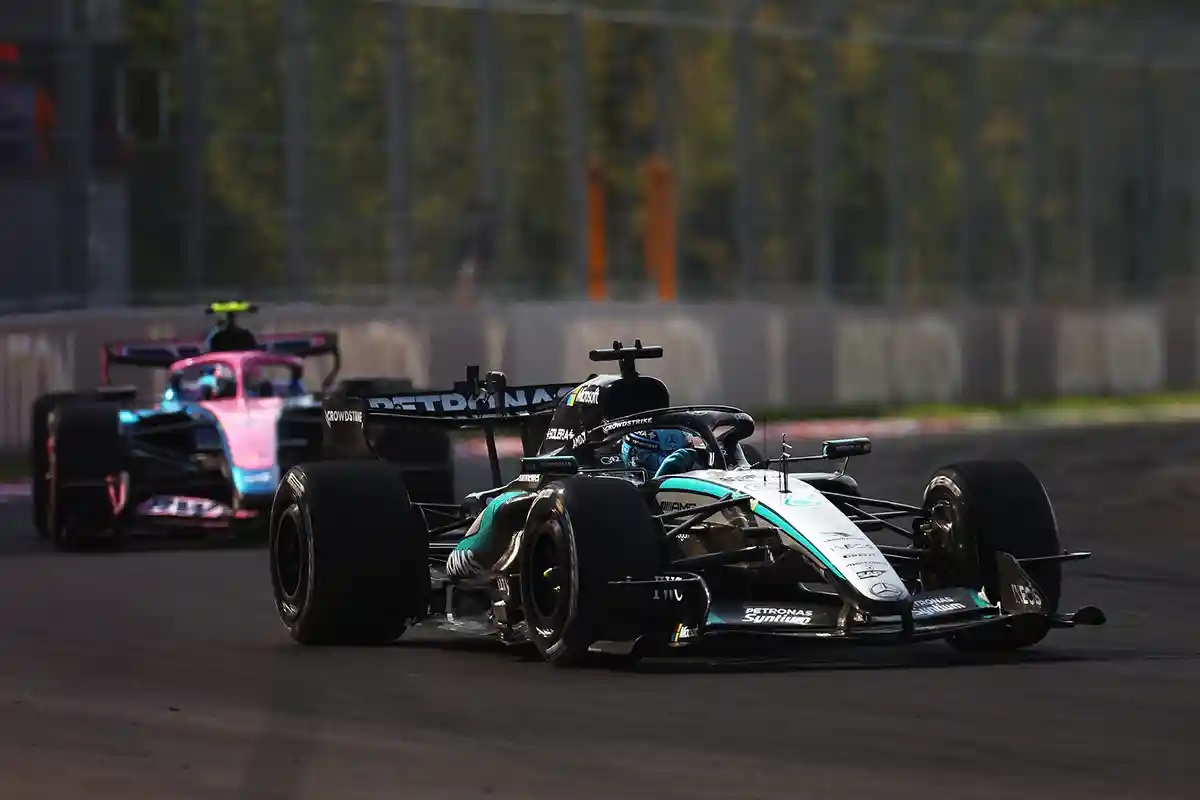
George Russell is not going to take his grid penalty until Mercedes has something worth taking it for. That decision, confirmed in Madrid, pushes the moment back from the Azerbaijan flyaway sequence to the American triple-header, and it hands his team mate a free upgrade in the middle of a championship they are both trying to win.
“We were always going to take my penalty with the ADUO upgrade,” Russell said. “Otherwise, if I took it there, I’d have to take it again. So it makes zero sense for me.”
Baku looked like the obvious place to take it
The 2026 regulations allow each driver four internal combustion engines across the season. A fifth brings a ten-place grid penalty, and Mercedes has already been through its allocation once this year because of early-season reliability problems.
Azerbaijan was the natural place for Russell to pay. Baku has the longest straight on the calendar and a history of drivers carving through the field, which makes a back-row start cheaper there than almost anywhere else.
Mercedes decided otherwise, and the logic is hard to argue with. Take the penalty on the current engine and you take it again when the upgraded one arrives. Take it on the new specification and you only pay once, then run the better engine for the rest of the year.
Antonelli gets the same upgrade without the penalty
The part of this that has gone almost unreported is what it means for the other side of the garage.
Kimi Antonelli took his hit at Monza, where Mercedes fitted a fifth internal combustion engine along with a new battery and control electronics. He started nineteenth and won the race, which is the single best advertisement for taking a penalty at the right circuit that anyone has produced this season.
What he did not change at Monza matters more now. His turbo, MGU-K, exhaust and ancillaries were left alone. When the ADUO specification arrives, Antonelli can take those components with it and stay where he qualifies. Russell takes the same upgrade and starts ten places further back.
That is not a team decision or a favour. It follows mechanically from which parts each driver has already used. The effect is still that the driver who is behind in the championship absorbs the cost of the upgrade, and the driver who is ahead does not.
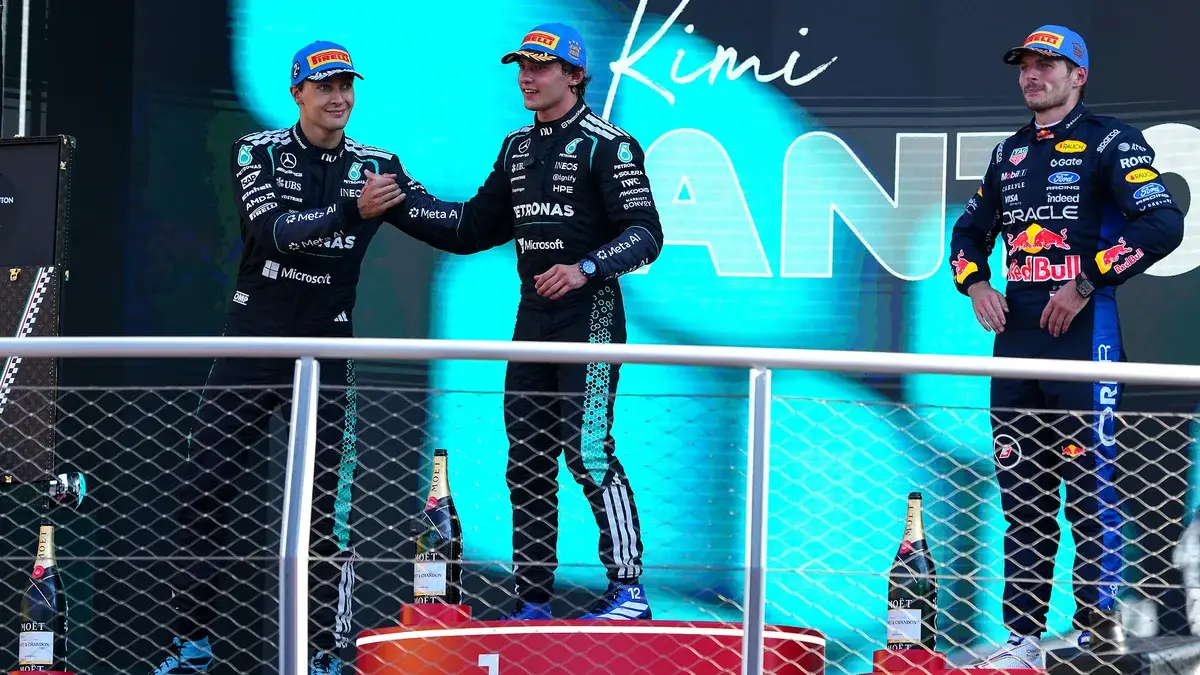
The team leading both championships qualified for catch-up help
There is an oddity sitting in the middle of this story that deserves more attention than it is getting.
ADUO, the Additional Development and Upgrade Opportunities system, exists to stop a manufacturer being stranded for years if it gets the new power unit rules wrong. It measures the internal combustion engine alone against the benchmark, not the complete power unit. Mercedes fell inside the two to four per cent band against Red Bull’s benchmark engine in the relevant measurement window, which unlocks one additional upgrade opportunity.
So the team with a 122-point lead in the constructors’ championship, and both cars in the top two of the drivers’ table, is taking a catch-up upgrade. Nothing about that breaks the rules. It is simply what happens when you measure one component instead of the package.
It is also the same mechanism that, on the same weekend, the FIA president was discussing extending further for Honda, a manufacturer that is genuinely stranded. One system, two very different problems.
Austin changes the arithmetic
The upgrade had been expected during the Azerbaijan, Malaysia and Singapore run. It now looks more likely to appear in the United States, Mexico and Brazil triple-header that begins at the Circuit of the Americas on 23 October.
That timing is not neutral. Austin has a long uphill run to the first corner and a layout that rewards a car with pace, which makes a penalty survivable. Mexico City sits at altitude with a start straight that produces chaos rather than overtaking, and Interlagos is short, busy and frequently wet. Where in that sequence Mercedes chooses to spend Russell’s penalty is worth more than most people will assume.
Russell was asked in Madrid about the championship and gave an answer that was either perspective or the most composed public face in the paddock.
The RNT verdict: the penalty is cheap, the precedent is the expensive part
Ten places at the right circuit is not what decides this championship. Antonelli proved that at Monza from nineteenth. Russell is 66 points behind with ten rounds left, and a single compromised Sunday is not the difference between those two numbers.
What the penalty does is compound something that is already true. Mercedes has pushed the W17 hard enough to burn through its engine allocation, and the bill for that is being split unevenly. Antonelli paid his at a track where it cost him nothing. Russell pays his later, on a weekend nobody has chosen yet, while trying to close a gap that only gets harder to close.
| Championship | Position |
|---|---|
| Drivers | Antonelli 267, Russell 201, Hamilton 191, Norris 171 |
| Constructors | Mercedes 468, Ferrari 346, McLaren 287 |
Standings before the Spanish Grand Prix.
The constructors’ gap is the reason Mercedes cannot simply write off a race. McLaren is 59 points behind Ferrari and climbing, and a team that banks points from one car is a team that stops extending its lead. Mercedes needs both drivers scoring, which is exactly what a grid penalty interrupts.
The larger point is the one about ADUO. A mechanism designed to rescue a manufacturer who got it wrong is being used by the team that got it most right, because the regulation measures a single component rather than the result. That is not cheating. It is a badly drawn line, and it is being argued over in public at the same time as a second concession is being discussed for an entirely different reason. Rule frameworks lose their authority when they start looking negotiable.
What to watch
Three things. When the ADUO specification actually appears, because Mercedes has already moved the date once. Whether Mercedes brings it to both cars at the same race or splits it. And which of Austin, Mexico City and Interlagos the team picks to spend Russell’s penalty at, because that choice tells you how worried they are about the drivers’ title.
We are covering the Spanish Grand Prix weekend as it happens on the RNT-Motorsports live blog.
The RNT Weekly newsletter
Race weekend times, results and our best stories in your inbox. Free, and you can unsubscribe at any time.