Race control stopped the clock in final practice after Hamilton hit the barrier
Hamilton crashed at Turn 22, ignored repeated team radio calls to stop, and now faces a potential grid penalty heading into qualifying at the Madring.

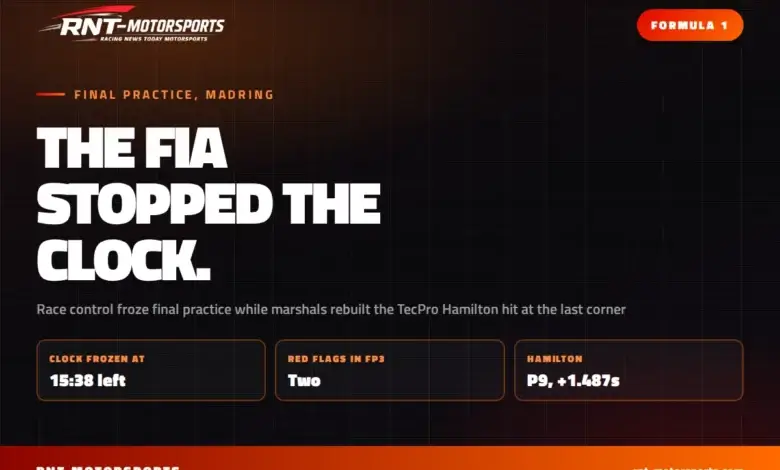
Lewis Hamilton understeered into the TecPro barrier at the last corner of the Madring with around 25 minutes of final practice to run. What followed was stranger than the crash: race control stopped the clock.
The session was frozen with 15 minutes and 38 seconds remaining while marshals tried to put the barrier back together, and it resumed only after the scheduled end of the hour. That is not how a red flag normally works in a Formula 1 practice session, where the countdown keeps running and the lost time is simply lost.
In this article
- Hamilton went off at the last corner
- Carlo Santi asked three times before he stopped
- The marshals needed a cherry picker
- Race control froze the session at 15:38
- Bearman ended it anyway
- Antonelli found nearly nine tenths on his Friday best
- Our verdict: the penalty is not the real cost
- Hamilton recovered to fourth on the grid
Hamilton went off at the last corner
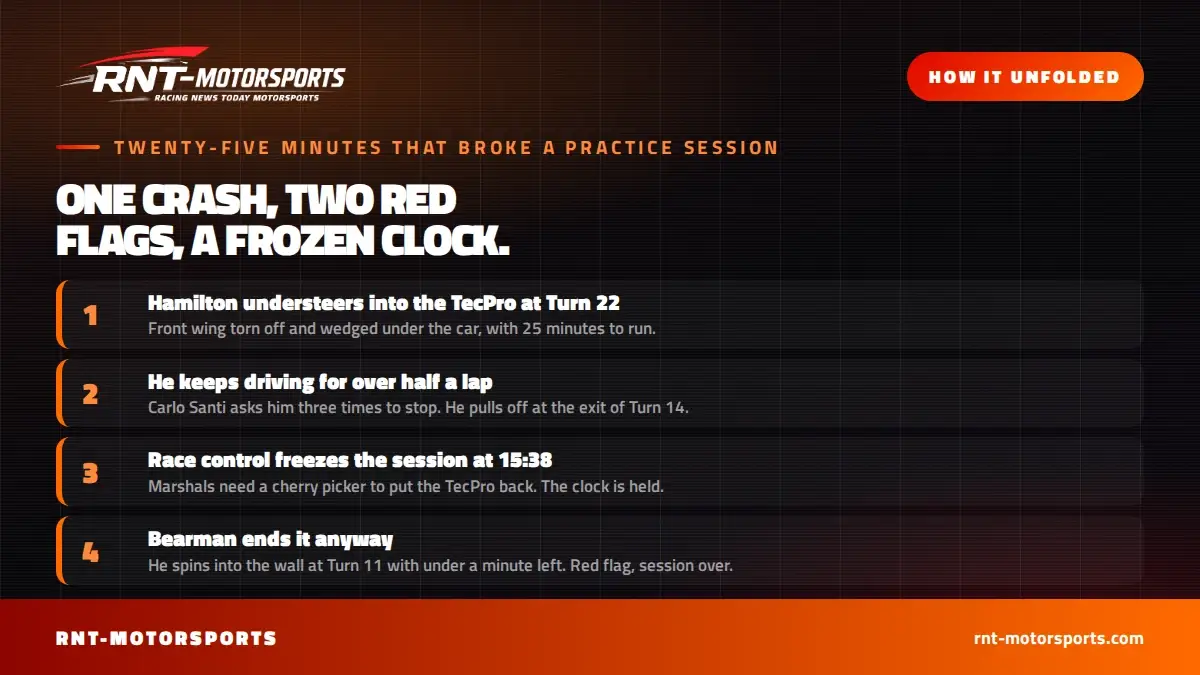
Turn 22 is the final corner at the Madring, and it feeds straight onto the pit straight. Hamilton lost the front end on the way through it and went into the TecPro on the outside. The car itself came off relatively lightly. The front wing did not: it tore away and ended up wedged under the floor, partly beneath the front wheels.
Our circuit preview flagged this layout as one that punishes small mistakes, and after two days of it there is now a pattern. Arvid Lindblad hit the barriers in second practice on Friday. Hamilton and Oliver Bearman both did it on Saturday.
Carlo Santi asked three times before he stopped
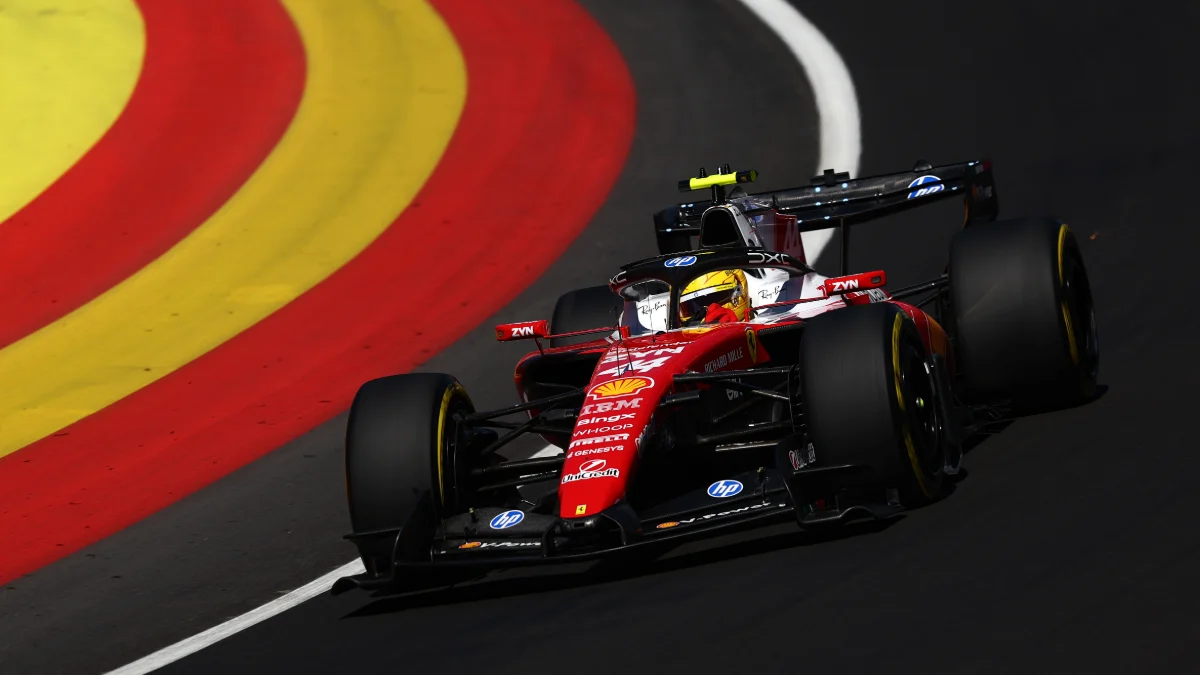
Hamilton wanted to bring the car back. His race engineer Carlo Santi did not want him to, and said so repeatedly, eventually telling him to stop the car in the safest place he could find.
Hamilton kept going for more than half a lap with the wing dragging underneath the SF-26, before finally pulling off at the exit of Turn 14. By then there was debris spread across a live circuit and the red flag was already out.
Williams team principal James Vowles said afterwards that Hamilton should have stopped sooner rather than try to reach the pits. Sky Sports analyst Anthony Davidson went further, warning that the episode set a poor example for younger drivers watching how a damaged car gets handled.
The marshals needed a cherry picker
Repositioning a TecPro block is routine work at circuits where the marshals have done it a hundred times. At a track holding its first Formula 1 weekend, with a marshal corps that has never had to do it under a Formula 1 clock, it was not routine at all.
The crew needed a cherry picker to get the barrier back into place, and the job kept running past the point where the session could have resumed. On the world feed it looked like a job that would take five or eight minutes. It took far longer.
Race control froze the session at 15:38
With the repair still going, race control sent a message that read: “FP3 will be temporarily stopped as barrier repairs continue.” The clock was held at 15 minutes and 38 seconds.
The reasoning is straightforward once you see the problem. In practice the countdown does not pause for a red flag, so a long stoppage simply deletes running time. On a circuit where every team is still building its baseline from zero, deleting the second half of final practice before qualifying would have been a serious sporting penalty applied to everybody for one driver’s mistake.
The session came back two minutes after its scheduled end and ran the remaining time out, resuming at 13:32 local. We cannot find a precedent for a Formula 1 practice session being paused on the clock in order to preserve practice time.
Bearman ended it anyway
Whatever the fifteen minutes were worth, they did not run to the end. With under a minute left Bearman spun through the Turn 10 right-hander and hit the barrier hard at Turn 11, which brought out the second red flag of the session and closed it for good.
Bearman was 13th, 1.684 seconds off the pace, and goes into qualifying with a repair job on his hands.
Antonelli found nearly nine tenths on his Friday best
Kimi Antonelli topped the session with a 1:32.797, which is 0.865 seconds quicker than the 1:33.662 that led Friday, as covered in our second practice report. The track is rubbering in exactly as Pirelli said it would.
| Pos | Driver | Team | Gap |
|---|---|---|---|
| 1 | Kimi Antonelli | Mercedes | 1:32.797 |
| 2 | Charles Leclerc | Ferrari | +0.166 |
| 3 | Oscar Piastri | McLaren | +0.189 |
| 4 | Lando Norris | McLaren | +0.236 |
| 5 | Max Verstappen | Red Bull | +0.375 |
| 6 | George Russell | Mercedes | +0.702 |
| 7 | Liam Lawson | Red Bull | +1.105 |
| 8 | Nico Hulkenberg | Audi | +1.136 |
| 9 | Lewis Hamilton | Ferrari | +1.487 |
| 10 | Gabriel Bortoleto | Audi | +1.491 |
Final practice at the Madring, top ten.
Leclerc second and Hamilton ninth is the line that will bother Ferrari more than the barrier did. Hamilton crashed before he had a representative lap in him, and the running he lost is the running he needed most after identifying balance as his problem on Friday.
The tyre picture behind all of this is in our report on the graining and the Hard compound.
Our verdict: the penalty is not the real cost
The stewards did not open one. Race director Rui Marques had already sent Ferrari a formal request to stop the car, and once Hamilton complied that was the end of it. Article B1.8.7 obliges a driver to leave the track as quickly as is safely possible when his car has clear and significant damage, but whether a given car falls under it is a judgement rather than an automatic offence, and three things pointed the same way here. This was a practice session and not a race, the circuit was already under a red flag with no marshals working on the surface, and Hamilton did stop in the end.
We would still have understood a closer look. A driver who decides for himself that his car is safe enough to keep moving is making a call that belongs to the race director, and the whole field watches how that gets treated. The FIA weighed intent and outcome instead, and on those two the case was thin.
The stewards were never the expensive part of the afternoon anyway. Hamilton finished the session ninth, on a circuit nobody has raced on, with no long run data and a car he still wants more balance from, while his team mate was second. That is what the barrier actually cost him.
Hamilton recovered to fourth on the grid
The lost running did not hurt as much as it looked like it would. Hamilton qualified fourth at the Madring, 0.189 seconds off pole and six thousandths clear of Leclerc, in a session that ran to the end without a red flag even though every driver had to work at the limit to make the cut.
Lando Norris took the first Madring pole by 0.011 seconds from Antonelli, with Max Verstappen third. The session is covered in our qualifying report.
The full grid, including the penalties handed to Carlos Sainz and Lance Stroll after the session, is on our Spanish Grand Prix results page.
The race starts at 15:00 local time. Follow it on the RNT-Motorsports live blog.