Why Gasly lost his Monaco podium three months after the race
The FIA's International Court of Appeal has ended Pierre Gasly's three-month wait for clarity, and the verdict cuts deep for Alpine in the constructors' fight.


The Monaco Grand Prix was run on 7 June. Its result changed on 3 September. That gap, not the podium itself, is the story worth telling.
The FIA International Court of Appeal has reinstated the two five-second penalties given to Pierre Gasly for speeding in the Monaco pit lane, overturning the stewards’ decision to rescind them in June. Isack Hadjar gets his third place back. Oscar Piastri moves up to fourth. Gasly is classified seventh, which is where he finished on the day.
Most outlets ran this as breaking news last night. What follows is the part that got less attention: what the court actually decided, and why.
Four tenths over the limit
Gasly was recorded at 60.4 km/h and 60.5 km/h in a pit lane limited to 60. Two five-second penalties followed. They dropped him from third to seventh, and the podium went to Hadjar.
The margins tell you how fine this was. Four tenths and five tenths of a kilometre per hour, on a measurement taken over a few metres of tarmac.
Seventy-seven centimetres
Alpine petitioned for a review on 11 June. Its argument was not that Gasly had driven more slowly than the system recorded. It was that the system had measured the wrong distance.
The Official Timing System calculated Gasly’s speed using a Pit Entry Loop Sector length of 2692 centimetres. Alpine, reconstructing the lap from satellite positioning data, argued the distance the car actually covered was 2615 centimetres. Speed is distance divided by time, so a shorter distance over the same time means a lower speed, and a lower speed means no offence.
The stewards accepted that as “a significant and relevant new element” and rescinded both penalties on 12 June. Gasly was reinstated in third. Hadjar dropped to fourth, Piastri to fifth.
McLaren and Red Bull appealed. The case was heard on 25 August and decided on 3 September.
The court never ruled on his speed
This is the part worth reading twice, because the court did not rule on whether Gasly was speeding.
It ruled on which measurement counts.
The court’s central point was about fairness across the whole field. Every team calibrates its pit lane approach against the same official parameter during a race weekend. If that parameter can be replaced afterwards by a different figure for one car, then the drivers who lifted early and lost time were competing under one rule and the driver who did not was judged under another. In the court’s framing, once competitors have calibrated against an official event-wide measurement, sporting fairness requires that the parameter stays fixed for the competition.
The second point was about proof. The court found that the 2692 centimetre figure was itself accurate as an official parameter, and that Alpine’s satellite-based reconstruction, however carefully done, was a best estimate rather than a measurement. It could not establish with centimetric certainty which line the car took. A faster elapsed time through the sector could mean a shorter path, or a higher speed, or both, and the reconstruction could not separate them.
So the appeals were granted, the June decision was set aside, and the penalties came back.
The bill lands on Alpine
A podium, and the points that go with it. In a constructors’ championship where Alpine is fighting Racing Bulls for fifth place, the difference between third and seventh at one race is not a rounding error. It is the kind of margin that decides where a team finishes the season and how much prize money it collects.
Alpine has not accepted the reasoning. The team says it still fully maintains that car number 10 did not exceed the pit lane speed limit at any point during the race.
Disappointed, and already looking at Saturday
Gasly heard the outcome on a Friday at Monza on which he had already given up first practice to Paul Aron. Speaking after second practice, in a statement issued by the team, he kept his focus on the weekend in front of him.
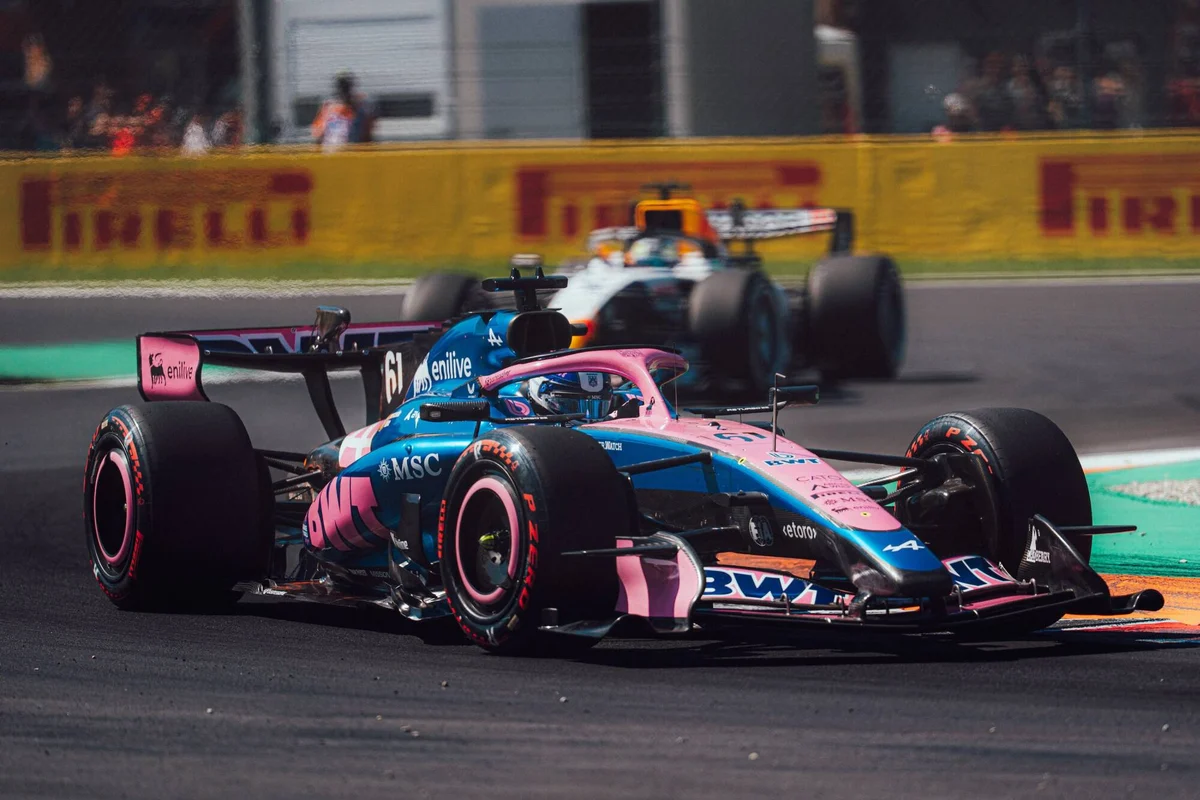
“A different Friday for me to normal as I sat out of Free Practice 1 with Paul in my car and it was interesting to see the session from a different perspective. In terms of my session in the car in Free Practice 2, I don’t think the leaderboard is an accurate reflection of our actual performance. There is some potential in the car here and I think the battle for the top ten will be close. We’ll have a few changes to make to find some improvements, and I am confident we can be in the mix for Q3. Obviously, we received the news of the Monaco Grand Prix result earlier today. I am of course disappointed, but my focus right now is only on this weekend’s race and maximising the result.”
Our view: eighty-eight days is too long
The court’s reasoning is coherent. The process that produced it is not.
A race result that takes eighty-eight days to settle is a failure of the system, not of the people inside it. Spectators who watched a podium ceremony in Monaco were watching something provisional. A driver stood on the second step of a rostrum he will now be told he was never entitled to. Sponsors have already used the images. None of that can be unwound by a document.
Penalties handed out during a race should be final when the race ends. That means the measurement they rest on has to be right before the flag falls, not argued over for a quarter of a season. If a timing parameter can be disputed to the centimetre months later, the answer is not a longer appeals process. The answer is a measurement nobody can dispute in the first place.
To the FIA’s credit, it appears to see the same problem. The governing body says it is reviewing the methodology and operation of the current Formula 1 timing system and the related regulatory matters. That review is the most important outcome of this case, more important than which driver ends up with fifteen points.
No further appeal
The classification and championship points have been amended. There is no further appeal route within the FIA’s own structure, so the Monaco result is now settled.
Hadjar, meanwhile, is not at Monza this weekend, as we reported when Liam Lawson stayed in the Red Bull. He regained a podium without being at the circuit to hear about it.
We are covering every session of the Italian Grand Prix in the RNT-Motorsports live blog.
The RNT Weekly newsletter
Race weekend times, results and our best stories in your inbox. Free, and you can unsubscribe at any time.