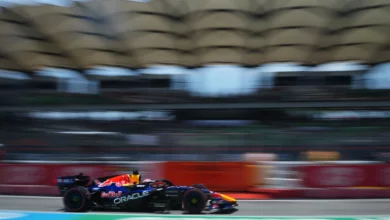
The FIA has officially declared an Austrian GP Heat Hazard for this weekend’s race at the Red Bull Ring in Spielberg. Formula 1’s governing body has declared a Heat Hazard for the Austrian GP, with mainland Europe smothered by its first major heatwave of the summer and Austria is one of several countries breaking June temperature records.
It is an extra challenge on top of an already action-packed weekend, with teams arriving carrying major upgrade packages. But what exactly does a Heat Hazard mean and why does it matter? Let’s break it down.
What Is the Austrian GP Heat Hazard Declaration?
With temperatures at Spielberg’s Red Bull Ring expected to hover in the thirties this weekend, forecasts triggered the FIA’s Heat Hazard protocol, which puts in place additional driver cooling procedures.
“In accordance with Article B1.5.10 of the FIA F1 Regulations, having received a forecast from the official weather service predicting that the heat index will be greater than 31.0°C at some time during the race at this competition, a Heat Hazard is declared,” the FIA stated.
In simple terms: if the temperature feels like more than 31°C, the FIA steps in to protect the drivers.
According to the FIA’s weather service, temperatures are expected to exceed the 31°C threshold on both Saturday and Sunday, with 32°C predicted during FP3 and qualifying, and 33°C expected at the race start on Sunday afternoon.
Formula One first introduced the Heat Hazard regulation in 2025, with the protocol first used at the Singapore Grand Prix.
This came after a number of drivers required medical attention after suffering heat exhaustion at the 2023 Qatar Grand Prix, with Lance Stroll going to the medical centre and George Russell saying he was close to losing consciousness. The FIA was not going to let that happen again.
This is also the first time in the 2026 season that a Heat Hazard has been declared. It will be the first time the new 2026 F1 engines face temperatures as high as those forecast for Austria, meaning teams will have to manage power unit cooling and tyre degradation carefully.
Cooling Vests or Ballast — The Drivers’ Choice
Drivers will be given the choice between wearing a cooling vest or having a corresponding 0.5kg of ballast attached to their cars. The FIA had long planned to make the cooling vests mandatory, but after pushback from drivers over their comfort and effectiveness, the device remains optional.
The FIA confirmed that the cooling systems on the cars are mandatory in the event that a Heat Hazard is declared. So the car must carry the system but the driver chooses whether to actually wear the vest.
Not all drivers are fans. Last season the FIA declared a Heat Hazard at the Singapore and Austin races, but not all drivers wore the vests, with Max Verstappen supporting the FIA’s decision to leave it up to the individual. “I just think it should be an option, that you can choose for yourself whether you want to wear it or not,” said the Red Bull driver.
Many drivers complained they found the vests uncomfortable during the 2025 Singapore Grand Prix, with Hamilton saying the cooling vests felt “itchy”.
There is also a weight impact for everyone. Due to the increased load on the cars, the standard 768-kilogram minimum car weight limit will change slightly, with an additional 2kg added for practice and qualifying, while a further 5kg increase will come into effect before the Grand Prix.
Why the Red Bull Ring Makes Heat Even More Dangerous
The Red Bull Ring’s 4.3-kilometre layout sits at 678 metres elevation in Styria, and its fast, compression-heavy corners already extract a physical toll even in moderate conditions.
Add extreme heat, and cockpit temperatures can exceed 50°C. That is like sitting in a very hot oven, for nearly two hours.
Europe is in the midst of a heatwave caused by a ‘heat dome’ a weather phenomenon where the atmosphere traps hot air as if capped by a lid, offering no relief from the heat.
Things will only get hotter as the weekend progresses, with the temperature warning upgrading from yellow to orange on Saturday and Sunday.
Drivers are in for a brutally hot race at the Red Bull Ring, which will challenge the reliability of the cars, the durability of tyres and the fitness of everyone involved.
Teams that manage cooling better than their rivals could gain a real edge, which makes strategy even more fascinating this weekend.
The heat also adds a new twist to an already intense battle at the sharp end of the championship. Mercedes’ Kimi Antonelli leads the Drivers’ Championship on 156 points, while Ferrari’s Lewis Hamilton sits second on 115 and George Russell is third on 106 points. Every tenth of a second and every degree of heat management, counts.
It’s not just the drivers feeling the pressure. Teams have brought major upgrade packages to Spielberg, meaning engineers will also need to balance car performance with thermal management. Red Bull have arrived with a significant upgrade package of their own, while Mercedes are demanding a strong response after Ferrari ended their winning run in Barcelona. Ferrari’s new ADUO turbo upgrade will also face its first real test in extreme heat, an added challenge for the Scuderia. And Cadillac are also pushing hard in the midfield with a substantial upgrade package of their own.
Looking Ahead: A Hot Race With High Stakes
Despite the extreme conditions, the FIA governing body said they do not expect the race to be suspended or delayed. So the show will go on, it will just be a very hot one.
The Austrian GP Heat Hazard adds yet another storyline to what is already shaping up to be one of the most fascinating weekends of the 2026 season. Drivers who stay cool — literally and mentally — could find themselves rewarded with a strong result on Sunday.
Want more from this weekend? Check out our full preview of the six key talking points for the Austrian GP, and find out what we think about the FIA’s other big regulation changes this week. It’s going to be quite a weekend in Styria.