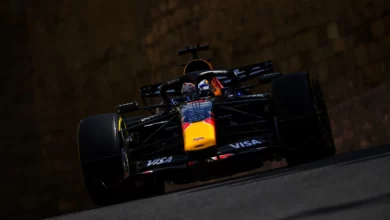
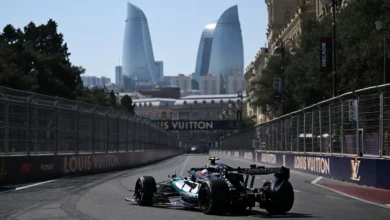
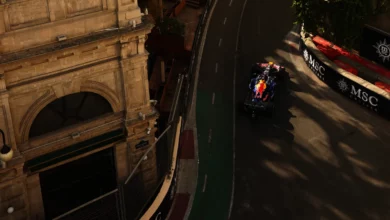
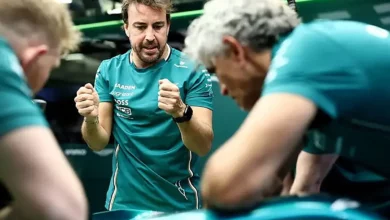
Mercedes brings nothing new to Baku, and the reason has been sitting in a drawer since June
The aero package starts in Malaysia, the ADUO engine waits for Austin, and George Russell’s grid penalty is what sets the date


Mercedes arrives in Baku this week with nothing new on the car. No aerodynamic package, no upgraded engine. The parts everyone has been waiting for are coming, but they land at two different races, and neither of them is this one.
The aerodynamic package starts in Malaysia next week. The engine, the one built around a token the FIA granted in June, is not expected until late October.
The aero package starts at the race with two countries in its name
Andrew Shovlin, Mercedes’ trackside engineering chief, put the timing on the record on the team’s own radio show. “The updates [are] going to come from Malaysia onwards,” he said. “And hopefully we’ll make a decent step.”
He was careful about how big a step. Mercedes is not expecting to move to the front, but Shovlin said he hoped the team would be back in a position to go into qualifying fighting for pole.
That race is on 2 to 4 October, and it is worth naming it properly, because half the coverage this week has it wrong. It appears on the calendar as the Formula 1 Gulf Air Bahrain Grand Prix in Malaysia. A Bahraini title sponsor on a race held in Malaysia, which is why some outlets are reporting a Bahrain upgrade and others a Malaysian one. It is the same weekend.
Twenty-six parts since Miami, the fewest of the top four
The wait has been long enough to show up in the paperwork. Every aerodynamic change has to be declared to the FIA, and since Miami in May, Mercedes has filed 26 of them. Ferrari has filed 39, McLaren 38 and Red Bull 35.
Mercedes has therefore been the least active developer of the four teams at the front for four months, and has stayed in the fight anyway. That is the argument for patience. It is also the reason the next package carries so much weight: there is not much season left to spend it in.
One extra homologation, granted after Canada
The engine side runs on a separate set of rules. Under the 2026 regulations the FIA can hand a manufacturer extra development if its internal combustion engine falls at least two percent behind the best one in the field. The mechanism is called Additional Development and Upgrade Opportunities, ADUO for short, and it is measured over three review periods a season.
In the first period, closing after the Canadian Grand Prix, Mercedes landed in the two to four percent band. That earned one additional homologation in 2026 and one more in 2027, along with an increase in its cost cap allowance and its dyno testing hours.
Audi, Ferrari and Honda all came out worse than four percent behind and were given two additional homologations in each of the two seasons. In the second review period, closing after Hungary, no manufacturer was granted anything at all. We covered those results in full when they were published.
So Mercedes has had one engine upgrade in hand since the summer. The question all season has been when it would use it.
In June the answer was that there was no upgrade at all
At the end of June, Toto Wolff was asked whether the fresh power unit components Mercedes had fitted in Austria carried any performance. His answer was flat. “No, they were just new power units,” he said. “With that comes less mileage, comes a little bit more spiciness. But there was no upgrade in it, and at the moment there’s no upgrade planned.”
That has changed. Mercedes is now understood to be building its ADUO allocation into a new specification, and the work has gone into the turbocharger rather than the internal combustion engine itself. The same components would reach the teams running Mercedes power, which makes this a change for more than one garage.
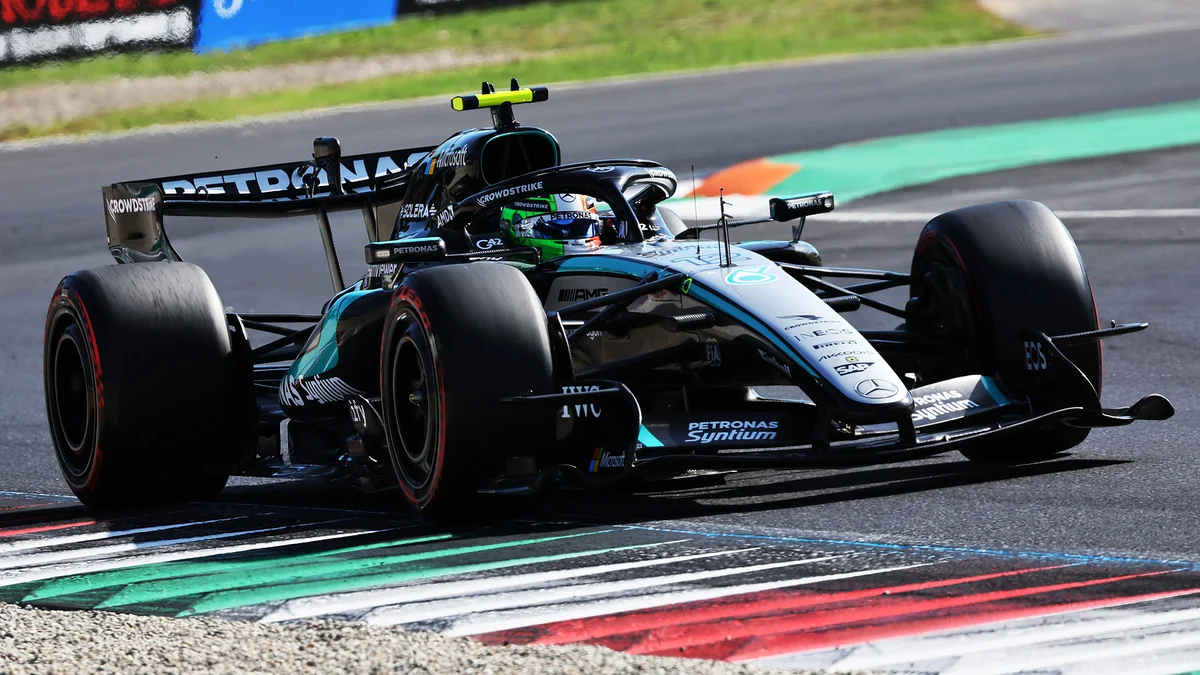
Russell’s penalty is what sets the date
The reason it is not appearing this week has less to do with the factory than with George Russell’s paperwork. He has used up his allocation of engine, turbocharger, energy store and control electronics for the season. The next fresh component he takes costs him a grid penalty whenever he takes it.
Taking one now and another when the upgrade arrives would mean two penalties. So he is taking one. Russell said he is waiting to take his penalty together with the ADUO upgrade, because “if I took it there, I’d have to take it again”, and that taking it twice made no sense for him.
Baku was the obvious place to serve it. A long run to turn one and a two kilometre straight make it one of the easiest circuits on the calendar to recover positions on. That plan was dropped. The penalty and the new engine are now expected together at the United States Grand Prix in Austin on 23 to 25 October, or at Mexico City the week after.
Ferrari has already spent what Mercedes is still holding
The contrast down the pit lane is stark. Ferrari was granted two ADUO allocations for this season and has used both, and is still short of power. Fred Vasseur has said plainly that the team is missing pure power and that closing the gap is a long-term project.
Mercedes, meanwhile, has been sitting on one allocation for three months while finishing races at the front. Whatever else the delay has cost, it has left them holding the last unspent engine card among the teams chasing the title.
Our reading of the calendar
Our reading of it is that Baku is a bad weekend to have nothing. This is a power circuit with one of the longest flat-out runs of the year, the kind of track where an engine step shows up in tenths on the timing screen rather than in a driver’s feel through a corner. Turning up with the same car and the same engine, one race before the aero package and three before the engine, is the price of the patience.
The part we would watch is not the lap time this weekend but the gap on the straight. If Mercedes is already competitive down to turn one without any of this, the upgrades arrive as a bonus. If it is losing ground there, the wait has been expensive and the recovery starts a week late.
Baku runs Thursday to Saturday
The Azerbaijan Grand Prix has an unusual shape this year. Practice runs on Thursday 24 September, qualifying on Friday, and the race itself is on Saturday 26 September at 15:00 local time, which is 13:00 in the Netherlands. Fifty-one laps of the Baku City Circuit.