
GT World Challenge Europe Explained
Every season the same question comes back, usually within minutes of somebody being handed a trophy: is this driver now the GT World Challenge Europe champion, or have they won something else? The answer is almost always “something else”, and the confusion is understandable, because the series runs three championships at once out of the same set of cars.
Here is how it fits together.
Two cups, one championship
GT World Challenge Europe is a single series with two halves. The Sprint Cup and the Endurance Cup each run five rounds, each has its own champion, and the points from both are then added together to produce the overall GT World Challenge Europe champion for drivers and for teams.
So a driver who contests the whole season is chasing two titles at the same time, and a driver who only does the endurance rounds is chasing one. That is why you regularly see a name high in the Endurance Cup standings who barely registers in the overall table.
The Sprint Cup format
A Sprint weekend is two races of one hour each, run on Saturday and Sunday, with two drivers sharing the car. Each race has a mandatory pit stop inside a set window for the driver change. No refuelling, no tyre strategy games worth the name — the stop is there to swap drivers, and everything else is track position.
It rewards outright pace and clean racing. There is very little time to recover from a mistake.
The Endurance Cup format
An Endurance round is a single long race, usually three hours, with three drivers per car. The exception is the round everybody knows: the 24 Hours of Spa, which sits in the middle of the season and is the biggest GT race in the world.
Three hours changes the job completely. Stint length, fuel windows, tyre management, traffic and driver changes all matter, and a car that is a tenth slower can still win on execution.
How the points work
The points scale is tied to race length, which is why the standings are full of half points.
- Sprint race: 16.5 points for the win, sliding down to 0.5 for tenth.
- Three-hour endurance race: 25 for the win, down to 1 for tenth.
- Six-hour endurance race: 37.5 for the win, down to 1.5 for tenth.
- Pole position in your class: one bonus point.
- 24 Hours of Spa: points are awarded three times — at the six-hour mark, at the twelve-hour mark and at the finish.
That last line is the reason Spa can decide a season on its own. It is the only race on the calendar that pays out three times.
Pro, Gold, Silver and Bronze
Every driver holds an FIA categorisation — Platinum, Gold, Silver or Bronze — based on their record and professional status. Cars are then entered into a class according to the mix of drivers on board.
- Pro: no restrictions. These crews race for the outright win and the outright titles.
- Gold Cup: Gold-rated drivers with one Silver permitted.
- Silver Cup: Silver-rated drivers only, generally the youngest field.
- Bronze Cup: built around a Bronze-rated driver, usually the owner or a gentleman driver, paired with professionals.
All of them race at the same time on the same track, and each class keeps its own standings. Look closely at any GT World Challenge car and the class is written on it — you will see PRO, GOLD, SILVER or BRONZE next to the number.
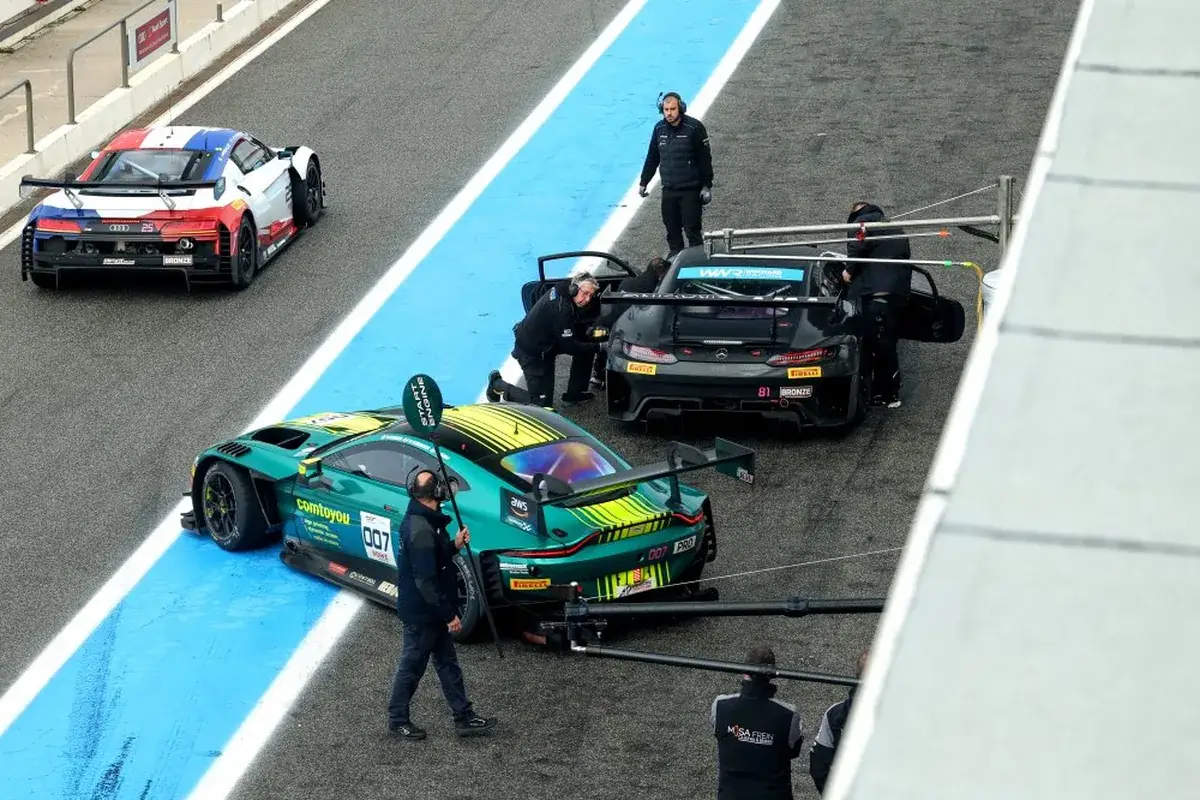
Look at the doors: the #007 Aston Martin carries PRO, the cars behind it carry BRONZE. Photo: SRO Motorsports
Why “overall” does not mean what you think
This is where most of the confusion starts. Inside GT World Challenge, overall is not a synonym for season. It is the label for the outright category, as opposed to Gold, Silver and Bronze Cup.
So a graphic reading “Endurance Cup — Overall Drivers” means the outright winners of the Endurance Cup. It does not mean the drivers have won the season.
A worked example from the Nürburgring
At the Nürburgring in August 2026, Lucas Auer, Maro Engel and Luca Stolz finished fourth and were declared Endurance Cup champions. The maths: they went in on 74 points, fourth in a three-hour race is worth 12, so 86. Their nearest rivals won the race and took the class pole, moving from 33 to 59. A gap of 27, with a maximum of 26 available at the Portimão finale.
Champions, by one point of margin — of the Endurance Cup. On the same afternoon, the overall championship stayed wide open, with Auer and Engel leading on 114.5 from Feller and Buus on 77 and five races still to run.
Same drivers, same weekend, two completely different answers to the question “are they champions yet”.
The full report on that afternoon is in Comtoyou Aston wins at the Nürburgring as Winward seal the Endurance Cup. For a series that runs a similar class structure with a very different grid, see GT3 Revival Series explained.